More Than Just Light: The Certificates Behind Our Low-Voltage Portable Lamps
Subtitle: Why CE, RoHS, FCC, IP ratings, and other certifications matter for your lamps.
Introduction
When you buy or sell low-voltage portable lights, what you can’t see matters just as much as what you can see. That’s where product certifications come in.
At Huiren , every product we manufacture must pass a series of international certification standards before it reaches your hands.
Let’s walk through the key certificates that back our lights — and why they protect you.
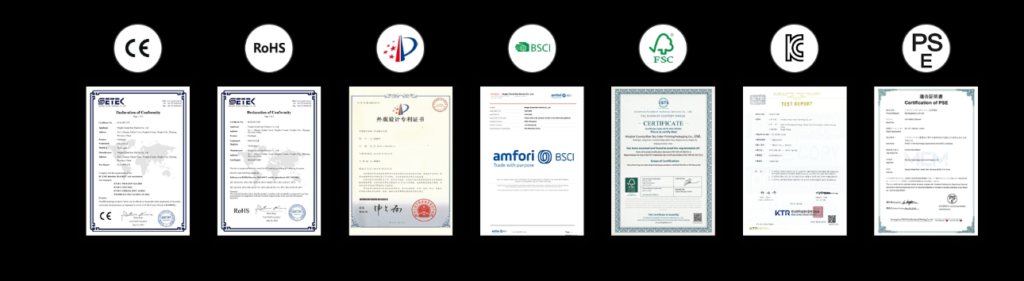
1. CE Marking (Europe)
What it means:
The CE mark indicates that a product complies with EU safety, health, and environmental protection requirements.
Why it matters:
The lamps are tested for electromagnetic compatibility (EMC) — meaning they won’t interfere with other electronics like radios or medical devices.
Low-voltage directive (LVD) compliance ensures no risk of electric shock (even though our products run on safe 3.7V–6V systems).
Without CE, you cannot legally sell lighting products in the European market.
2. RoHS Compliance (Restriction of Hazardous Substances)
What it means:
RoHS restricts the use of ten hazardous materials, including lead (Pb), mercury (Hg), cadmium (Cd), and certain flame retardants.
Why it matters:
The book lights contain zero lead in solder or components — safe for children who might put things in their mouths.
Our lamps use cadmium-free solar cells, protecting soil and groundwater.
RoHS compliance is mandatory for Europe and increasingly required in North America and Asia.
A RoHS label means you can recycle the product at end-of-life without releasing toxins.
3. FCC Certification (USA – electromagnetic interference)
What it means:
The FCC (Federal Communications Commission) certifies that electronic devices do not emit harmful radio frequency interference.
Why it matters:
The lamps contain LED drivers that operate at high frequencies. FCC testing ensures they don’t disrupt Wi-Fi, Bluetooth, or nearby sensitive equipment.
Even simple night lights with auto-dimming sensors must pass FCC Part 15B (unintentional radiators).
Without FCC, your products may be stopped at US customs or returned by distributors.
4. IP Rating (Ingress Protection – Water & Dust)
What it means:
IP ratings tell you how well a product resists dust (first digit) and water (second digit). Common ratings for our products:
Rating | Dust protection | Water protection |
IP44 | No dust protection (but >1mm objects) | Splashing water from any direction |
IP54 | Limited dust protection | Splashing water |
IP65 | Dust-tight | Low-pressure water jets (rain-proof) |
IP67 | Dust-tight | Temporary immersion (1m for 30 min) |
5. UKCA Marking (United Kingdom)
What it means:
UKCA is the post-Brexit equivalent of CE for products sold in Great Britain (England, Scotland, Wales).
Why it matters for our lights:
UKCA requires the same safety and EMC testing as CE, but with UK-approved bodies.
If you see both CE and UKCA on our products, you can sell freely in both the EU and the UK.
6. REACH (Chemical Safety – EU)
What it means:
REACH (Registration, Evaluation, Authorization of Chemicals) controls the use of very hazardous substances in manufactured goods.
Why it matters:
The lamps have plastic housings and rubber grips that must not contain phthalates or SVHC (Substances of Very High Concern).
REACH compliance is especially important for children’s products like small book lights or DIY lamp kits.
When you choose our low-voltage portable lights, you get proof of safety, compliance, and quality.
Need certified lights for your next project?
Contact us to request our certificate package or discuss custom OEM/ODM requirements.
Safe. Compliant. Trusted.
— The Huiren Quality Team